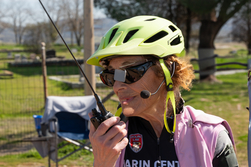
Here are some practical tips for getting on the repeater and sounding like a pro when you’re new – and if you’ve been around a while, tips to remind you to always be your best.
Starting a QSO
A directed call is where one amateur calls another amateur individually, such as “N6XYZ from K6ABC.” In this case, K6ABC is looking for one particular individual, N6XYZ. It generally is not an invitation for anyone other than N6XYZ to return the call. If N6XYZ does not answer, K6ABC may clear off by saying “K6ABC clear,” or may clear and listen for other calls by saying “K6ABC listening.”
The phrase “listening” or “monitoring” implies that the operator is interested in remaining available for a QSO with anyone else who may be listening. If the repeater is not in use, simply stating your callsign followed by “listening” or “monitoring” is enough to show that you are available for a conversation.
Calling CQ on a repeater is generally not an acceptable practice; a simple “N3XYZ listening” will suffice. There is no need to repeat the listening message over and over as you might when calling CQ on HF. Once every several minutes is usually sufficient. Avoid phrases such as “Is anybody out there?” or “Is there anybody around on frequency?”
Joining a QSO in Progress
If there is a conversation taking place that you would like to join, simply state your callsign during the hang time after one user ends their transmission. The courtesy tone exists to allow other users to break into the conversation. One of the stations in the QSO will usually invite you to join.
You should not interrupt a QSO unless you have an emergency, need to make a call to another station, or have something relevant to add. If interrupting to make a call, break in during the courtesy tone by saying, “Call please, N6XYZ.” If the station you are calling returns your call, quickly move off frequency or pass traffic and return the frequency to the stations already in conversation.
Roundtables and Turning It Over
When more than two amateurs are in a QSO, it is often called a roundtable discussion. The discussion usually moves in sequence from one station to the next. To keep everyone organized, each operator should turn it over to the next station when finished speaking. Without turning it over to a specific station, it may be unclear who should speak next, which can result in silence or multiple stations transmitting at once. End a transmission by naming the next station or giving their callsign, such as “Go ahead, Joe” or “Go ahead, XYZ.” If close to ten minutes have passed, identify at the same time.
IDs and Who’s Who
FCC regulations require operators to identify at ten-minute intervals and at the end of a transmission. If you are making a test transmission or calling another party, identify each time you make the call or test transmission.
When identifying yourself and another party, or when making a directed call, your callsign goes last. “N6XYZ, K6ABC” means that K6ABC is calling N6XYZ. There is no need to identify every time you transmit; once every ten minutes and at the end of the contact is sufficient.
Demonstrations
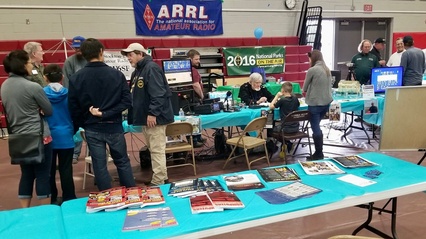
From time to time, an amateur may want to demonstrate the capabilities of amateur radio to someone who is not licensed. A typical way to do this is to ask for a demonstration, such as “N3XYZ for a demonstration.” Anyone listening may respond. In most cases, the calling station is looking for a name, callsign, and location rather than a lengthy conversation.
Signal Reports
If you are unsure how well you are making it into the repeater, do not simply key the microphone or “kerchunk” the repeater. Any time you key up the repeater, you should identify, even if you are only testing. “N6XYZ test” is sufficient.
If you need someone to verify your signal, ask for a signal report, such as “N6XYZ, can someone give me a signal report?” “Radio check” is more commonly associated with CB; amateur operators generally ask for a signal report.
Language
Use plain conversational English that would be suitable for general audiences. If a topic begins to draw strong debate, change the subject.
Avoid “radio-ese” whenever possible. CB has its own style of language, and so does amateur radio, but the two are not the same. When visiting a new repeater, take time to monitor before jumping in so you can understand the traffic and operating style of that system. Listen before you talk is the golden rule of good operators everywhere.
It goes without saying that foul, abusive or obscene language is NEVER acceptable and it violates the rules.
Malicious Interference
If there is malicious interference, such as kerchunking, touchtones, or rude comments, do not acknowledge it. Continue the QSO normally. If the interference becomes impossible to work around, end the QSO as you normally would.
Power
Use the minimum power necessary to complete a QSO. If someone reports that your signal is noisy, increase power or relocate to improve your signal. Continuing to transmit after being told your signal is noisy is inconsiderate to those listening.
Many new amateurs start with handheld radios because they are convenient, but handhelds are not always the most effective radios in terms of performance. Without a good external antenna, operating indoors or from inside a vehicle may result in poor signal reports. Small simple portable mag-mount antennas are available on line and at stores like HRO. Even indoors mounted on top of a metal railing or file cabinet can make a big difference in your signal.